i wonder if soil has heart. i wonder if blood, sweat, and tears do feed roots and flower fruit. if the earth itself has memory, and can she remember, somehow, all those who came and planted and ate here.
~ Suheir Hammad, Ramallah, 24 May 2009
There are many ways of being together. If collaboration emphasises an ethics of shared labour, symbiosis – adjacent, overlapping but not quite the same – is suffused with the energies of living bodies. As soon as we speak of symbiosis, as theory or practice, we are in the realm of the multiple and therefore in the realm of agency, power, duress perhaps, and desire. We also cannot think symbiosis without reference to time. As poet and curator Amy Todman writes in the exhibition text that accompanied In Symbiosis… ل.ل.خ, a temporary coming together of work by artists Sa’ad Choeb, Serene Debs and Yen’s Kitchen at Manzool Space in Damascus, Syria in February 2026: “symbiosis also holds a tension within, a crack, a slight misalignment, a space for something to grow”.
In 2025, following the fall of the Assad regime, artist Sa’ad Choeb returned to his hometown in Syria after years of forced displacement. At first, his studio – located near the city of Suwayda, close to Jordan and the occupied Golan Heights – appeared to have survived without damage; the work that remained behind apparently unscathed. But then Choeb noticed them: fungal growths, spreading – like something cartographic – across sixteen of his paintings. Choeb had long been engaged in grappling with questions of loss – friends and loved ones, a homeland, his work (many of Choeb’s paintings were destroyed in the Beirut port explosion of 2020). Instead of attempting to remove the mould, Choeb embraced it, finding in this living presence something like a more-than-human ally to his ongoing engagement with what we might call ecologies of grief, desire, memory and return.
Choeb trained as a painter, and, even before the Beirut port fire and his discovery of the moulds in Suwayda, he had established a practice that understood painting as a relationship between materials that could develop slowly over time. In combining water-based and oil-based paints, and letting the materials meet and mingle over the course of several years, Choeb adopted an experimental approach to archiving and history. Each painting became its own calendar: not only reframing ideas of time within alternative frameworks to the oppressive narratives of contemporary politics but also accepting the relinquishment of the artist’s own agency.
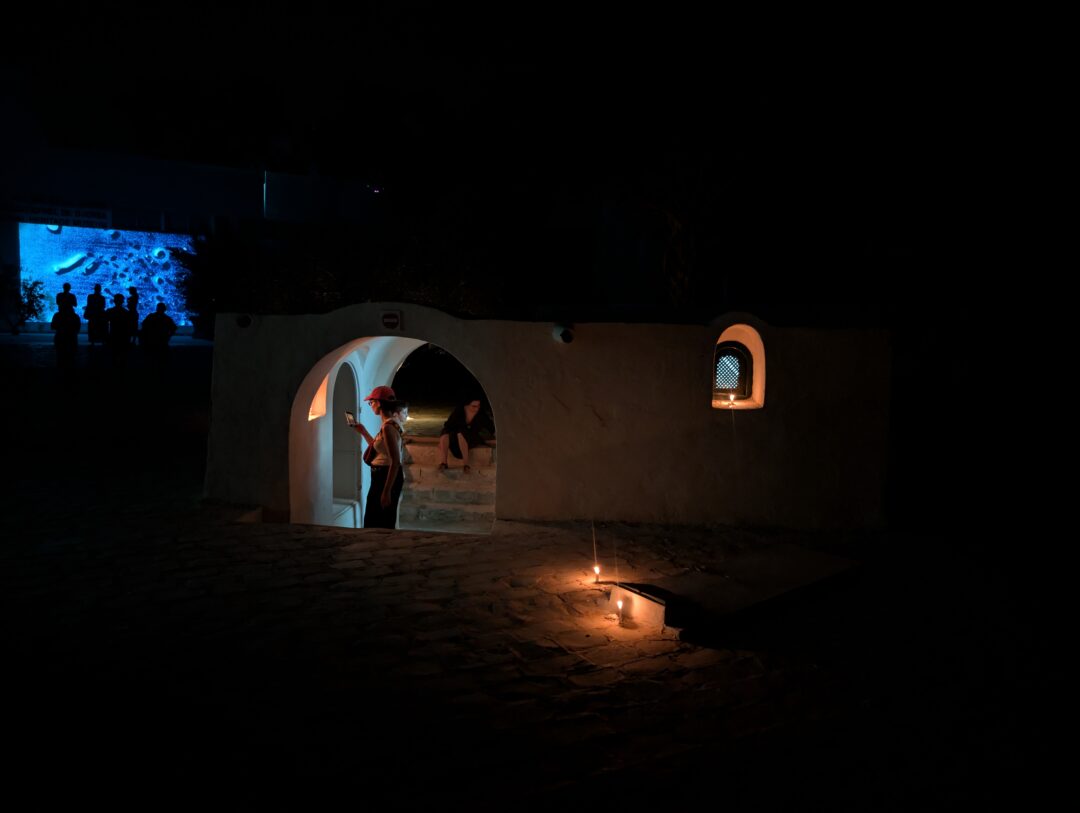
More recently, in 2026, Choeb has produced a body of work across three different iterations: In Tribute, a multi-sensorial installation in collaboration with sound research Bint Mbareh at The Museum of Heritage in Djerba, Tunisia; In Symbiosis… ل.ل.خ, part of a group exhibition at Manzool Space in Damascus, Syria; and His Eylid Taught Ghazal, curated by Ayman Gharbi for the Shubbak Festival at the University of Cambridge, UK. Each iteration incorporated live mould cultivated from paper recovered from the Choeb’s Suwayda studio, as well as film and audio elements, including footage from a return visit to Syria and biosignification of fungal activity. Each installation has been structured according to an imagined cycle of full moon and lunar eclipse. The result is an entanglement of layers, more akin to constellations than any conventional narrative.
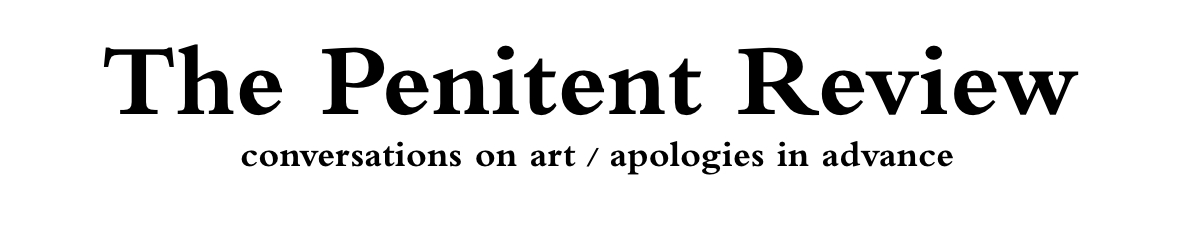
In repeatedly working with fungal beings, there is a sense in which Choeb reframes these agents of decay in terms of their generative potential. However, as much as we might read Choeb’s work as a celebration of the complexity of life, these installations engage deeply with loss and grief. For example, in the second iteration of the series, in Tunisia, the work was installed next to two unclaimed graves and a Sufi dergah (a shrine or tomb) within the museum grounds. This iteration involved a series of Sufi rituals involving candles and incense in memory of a friend of the artist, a poet whose own poetry of mourning was also included in the installation.
In making space for multispecies entanglements, Choeb’s work also questions hegemonic border regimes. Throughout 2026, Choeb has incorporated black basalt rocks into his work, both whole and ground down to use as pigment. Through informal networks of transport and exchange, these rocks have travelled from Suwayda (whose name, meaning black, is derived from the preponderance of basalt in the region) to act like material witnesses within Choeb’s work. In rural agricultural areas in Syria, these black rocks are used to signify borders of land ownership and use. For Choeb, however, their movement across nation-state and other administrative borders, and subsequent dispersal in multiple locations, offers a counter narrative to the ever more insidious enforcement of border technologies. If Choeb’s slow paintings are forms of calendar, then the stones constitute a kind of alternative map – a cartography perhaps reminiscent, formally at least, of the way mould grows too.
Ecology is broadly understood as the study of relations between living beings and their environments. In attending to connections across scales, from planetary to intracellular, ecology invariably complicates its own premise: that is, the assumption that it is is even possible to differentiate with rigour between the living being and the environment. The leaves of sphagnum mosses, for example, contain an outer layer of cells that absorb water. These cells are mostly dead. At a microscopic level, it can be almost impossible to differentiate between living lichen thalli and non-living substrate. Most of the cells in the human body are not actually ‘human’. Each of us is perhaps better thought of, therefore, as a multi-species assemblage: every self always other, already less an ‘I’ than a ‘we’. Only 1% of any tree is biologically alive.
Where Modernism conceived of art as a reflection of its own model of the individual subject (the illusion of the autonomous work), artists such as Choeb are more interested in situating art practice as one site among others in which multispecies entanglements can be practised with criticality. That mould was given the time to grow, undisturbed, in those sixteen paintings in the artist’s studio demonstrates that these entanglements are taking place anyway. Geneticist Em Merrin May Armstrong describes queer ecology as an attunement to “strange relationality”. The more sensitively we listen in to these relations, the better we can understand that there is nothing more strange or more commonplace than the entanglements of life and loss. In the particular instance of Choeb’s Suwayda studio, the fungal growth was the result of a specific interrelation of political, personal, climactic, material and temporal factors. In subsequently making space to think through such moments within an art practice, Choeb both frames entanglement in terms of intentionality while, at the same time, radically questioning the limitations of human agency. In the specificity of its references, and sensitivity to history and materiality, Choeb’s work constitutes a vital and multi-layered engagement with grief and desire, loss and return.
Image credits:
1. Sa’ad Choeb, The Museum of Heritage in Djerba, Tunisia, installation shot, 2026
2. Sa’ad Choeb, The Museum of Heritage in Djerba, Tunisia, installation shot, 2026


No Comments