
Prunella Clough at Thomas Dane
Ally Fallon at Hales Gallery
Nomenclature for the Time Being at Raven Row
Audrey Amiss at Wellcome Collection
One beautiful thing about visiting a lot of exhibitions in a short space of time is that they start to speak to each other. Each exhibition retunes your sensibility. Things gather, you find connection, maybe there is friction where one set of visions collides with another.
I’m thinking about abstraction – a thing I sometimes love. The gestural traces of a body in movement. The distillation of form. Patterns and structures that might reframe the world. Opacity that makes you work to look, think, look, try to disentangle one thing from another, fail, pause, try again. But sometimes I can’t help but wonder what it’s all for.
On a recent trip to London, I visited two focused solo exhibitions dedicated to abstract painters at opposite ends of their lives and careers. At Thomas Dane is a series of paintings from the 1980s and ‘90s by the venerable Prunella Clough, while Hales gallery in Shoreditch is showing new paintings by Ally Fallon, who last year became the youngest ever winner of the John Moores painting prize. When Clough died in 1999, at the age of 80, Fallon was just one.
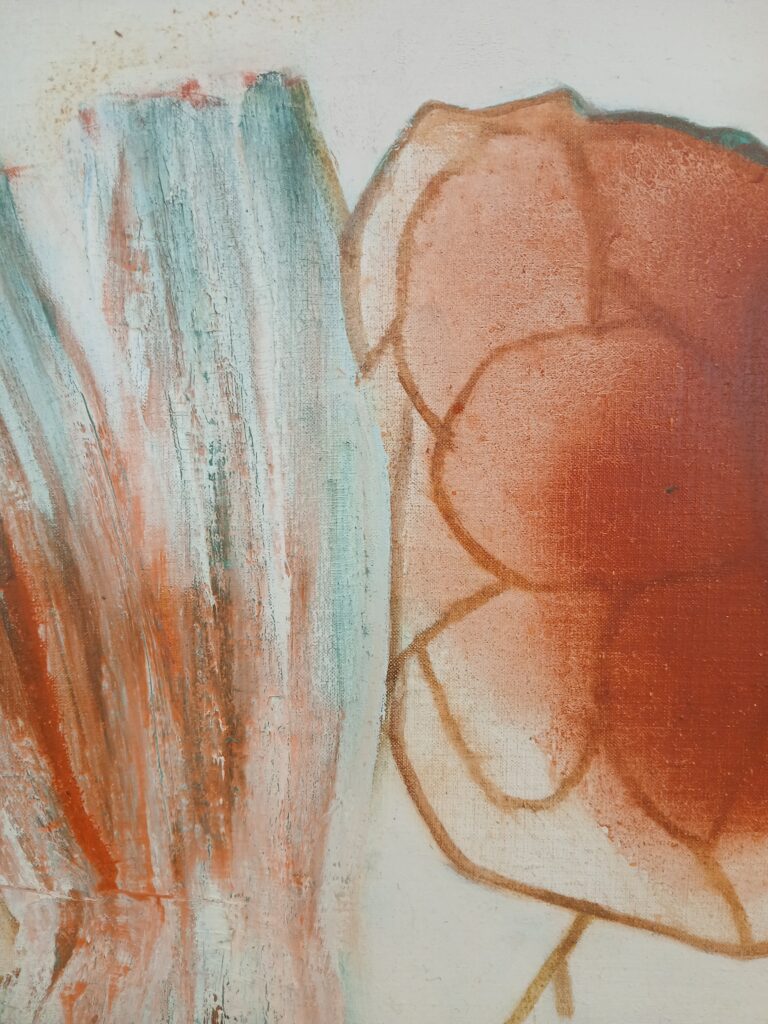
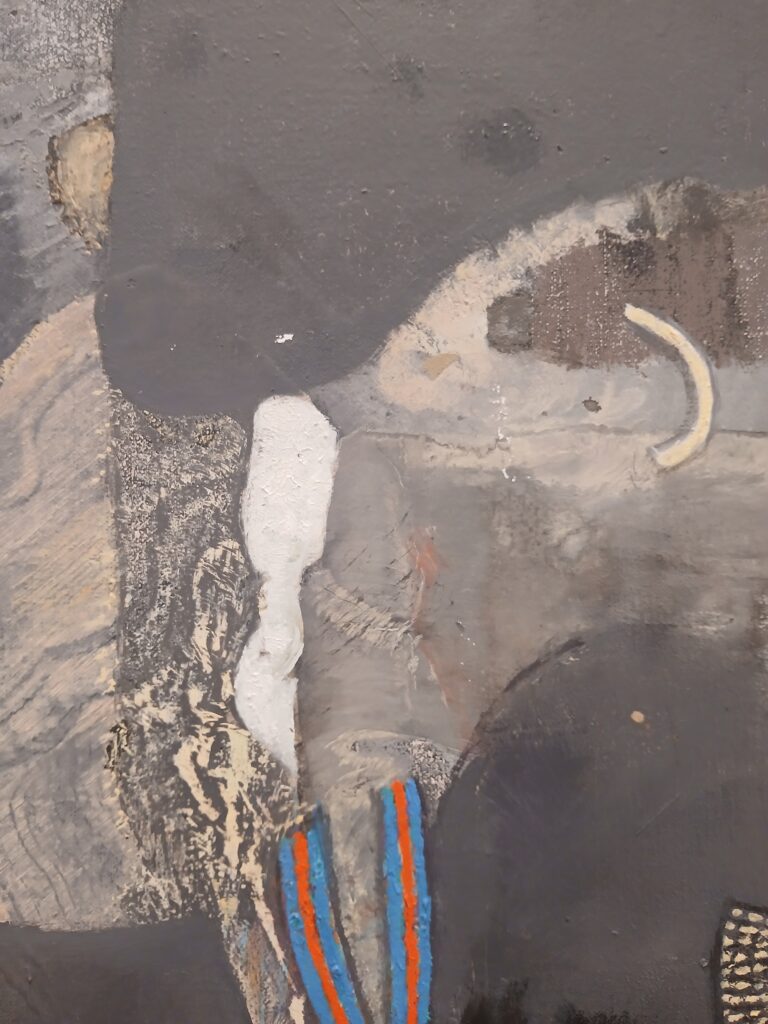
There are intriguing overlaps between the work of these two artists. As its title, Out and About, suggests, the exhibition of Clough’s work showcases an artist focused on mining the peripheries, an edgeland rummager, gathering patterns, forms and materialities (the shape of a gate, the texture of rocks, the whirl of a board game) and assembling them together into sparse, elegant paintings, fractured in places and mended by experimental or expressionist gestures.
Fallon, meanwhile, is currently doing one thing and doing it beautifully. Where Clough is outside, looking, collecting, Fallon stays inside, creating airy, capacious dream-like interiors. The bottom third of every painting is filled with patterned tiles, like inhabiting a Van Eyck stripped of all interior objects and figures. These emptied out spaces create a setting for a panoply of marks and forms, each of which feels like a nod to a different moment in art history: the dark arch from the background of a Titian, say; the transparent sails of Kandinsky’s early forays into abstraction; or a scrawly, bleeding Cy Twombly rose. Like Clough, Fallon understands the rhythmic relationship between calm and energy, the satisfaction created when spontaneity (or something like it) waltzes across repetition.


At Raven Row is a very different approach to abstraction, one that engages with materialities and political potencies as much as art historical legacies. Curated by Imani Mason Jordan, Nomenclature for the Time Being is a sculptural group show that borrows its title from the 2022 book-length poem by Dionne Brand. In an essay in the richly thought-provoking accompanying pamphlet, Nikita Sena Quarshie quotes a conversation between curator Hamza Walker and artist Torkwase Dyson (neither of whom are involved in the exhibition). Walker writes: “abstraction, freed from freedom, can now be put to work”.
This feels to me like a hugely generative proposal. Looking through it again, I notice that the info for both the Clough and the Fallon exhibitions references freedom: of Clough, Thomas Dane gallery notes “the freedom and strangeness she desired for her paintings”; Hales refers to Fallon’s repetitive process as a strategy that “frees the subconscious, allowing atmosphere, intuition, and unexpected gestures to emerge”. With Walker’s words in my mind after visiting both exhibitions, I can acknowledge the artists’ commitments to a certain conception of freedom, while at the same time wondering: to what end?


In a 2002 conversation with Christian Olbey (quoted in Christina Sharpe’s introduction to the 2022 Penguin collection of Dionne Brand’s poetry), Brand described her approach to writing as follows:
“I wanted to show that liberation was political thought, and liberation is aesthetic power.”
This idea of liberation as both political and aesthetic, as constituted by and with both thought and power (theory and practice) hums through Nomenclature for the Time Being. This is a materially charged, wide-ranging exhibition with an attunement to an embodied politic, that aims to coalesce towards “a Black feminist materiality, one that understands objects as social and political actors”. The work is by turns tender and brutal, spiky, soft, elegiac. There is both blurriness and precision.

There is a lot of brilliant work across Raven Row’s five floors of formerly domestic spaces: Ingrid Pollard’s kinetic sculptures, threateningly reminiscent of carceral institutions beside a black and white image of a young Black girl curtseying, derived from a propaganda film made by the British government’s Colonial Film Unit in 1944; Ebun Sodipo’s engagement with historic objects from Ghana, Egypt and an unnamed mid-Atlantic island to foreground deep histories of trans life, joy, and resistance against erasure; Deborah-Joyce Holman’s tiny texts written on human teeth, too small for me to read, a reminder against legibility, marks that overflow classification. Maren Hassinger’s works bracket the exhibition with humour, drudgery and joy. In a small dark room on the lower ground floor is a film that shows the artist lugging multiple plastic bags stuffed with clothes up and down the stairs within a home. On the top floor, in a space conserved as Rebecca’s flat, with all its period domestic details, a series of pink plastic bags fill the ceiling with love and air and lightness.
As a side note, I recently attended the launch of Shorelines, the new memoir by poet Alycia Pirmohamed. At the event, Alycia spoke of the ways in which people, especially marginalised people, are asked to give more and more of themselves in public – through their art, through social media, in interviews etc – and therefore how in such a context (which is at the same time that of the surveillance state) withholding certain details, stories and information can be thought of as a kind of decolonial practice.
This chimes very closely with some of the work at Raven Row, that of artist Christine Kirubi in particular. Kirubi’s mixed media installations evoke and resist ubiquitous technologies of surveillance (video, photography, instant messaging etc) removing in both the works themselves and their titles (sections of which are redacted) the specificity that can be mined as data or weaponised by a repressive state apparatus. Through the building, Kirubi has applied Vaseline to many of the windows, wiggled a finger through their surfaces. The effect is less about the apparent freedom of a gesture, more to foreground the materiality of visibility – the soft focus of a 1980s film camera, the transparency of glass, even air – while drawing our attention to the connections between inside and outside, the position of the gallery in relation to the street.


Some of these key areas of engagement – archives, domestic space, erasure, a tension around privacy and the withholding of information in the context of public exhibition-making, and the putting to work of abstraction – are also important currents running through an exhibition of work by Audrey Amiss currently at the Wellcome Collection. An artist and activist, Amiss also experienced significant struggles with mental health. She underwent psychiatric treatment and spent time in various institutions. The exhibition showcases sketchbook drawings and watercolours: paper wet, worked and crumbling, pencil scribbles hard and hectic, single hard-pressed lines washed over with delicate tones of lavender and lemon. The works show interior spaces, both domestic and institutional – bookcases, plants, chairs, views through gridded windows. A television set, blank like a portal amid carbon copy blue.

It is interesting that Amiss’s archive was donated to Wellcome and not, say, Tate, or another conventional arts institution. I don’t know the reasons for that, but Wellcome seems to have engaged with her legacy, for this exhibition at least, with dilligence and sensitivity. The exhibition raises many important questions, relating to art and mental health, how to decide what to exhibit and what not to. Looking at Amiss’s small-scale, intimate and powerfully gestural work prompts you to think about what freedom of expression really means within the confines of a carceral institution. Even when “freed”, for many marginalised people, carceral control is a threat that does not go away.
The exhibition also conveys something of its own research processes – specifically through a section that charts the attempt to track down works from Amiss’s exhibition Drawings from a Locked Ward (The Snakepit) made as acts of resistance against the force and detention she experienced at the hands of the psychiatry profession. The researchers failed to track down any of the exhibition’s 44 drawings. The works remain missing because Amiss distributed them – to publishers, politicians and others – as a way to raise awareness of the dire conditions facing those forced to deal with mental health institutions. She put her work to work.

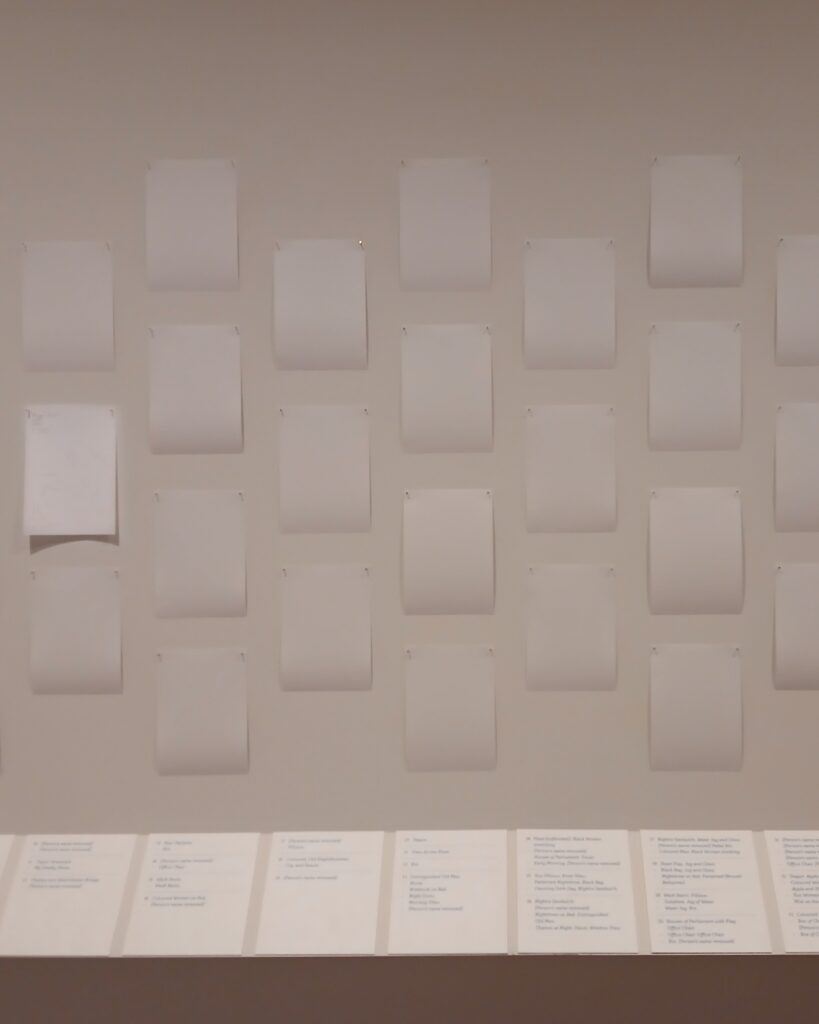
The curators have responded by staging, within the main show, a small exhibition of blanks – all 44 works, arranged as they would have been, but represented by sheets of white, unmarked paper. The titles are there but many names have been redacted to protect the privacy of those people, presumably fellow patients, depicted in the drawings. The result is striking, innovative, thoughtful and powerful. It points us towards institutional erasure, the importance of privacy within and against institutions that prioritise control over care, and, in Walker’s words again, the putting to work of abstraction.
Thinking about Audrey Amiss and about Imani Mason Jordan’s exhibition at Raven Row, something emerges around a difference between freedom and liberation. Nikita Sena Quarshie’s essay concludes by “refusing the lonely freedom of the autonomous and untethered individual”. If freedom, as conceived under modernism/capitalism, is individualistic, disconnected and ultimately even reactionary, then it must be cast aside in favour of working towards a liberation that is truly emancipatory, collective in both struggle and realisation. Or to put it more succinctly: “No one is free until everyone is free”.
Tom Jeffreys
Postscript
I also went to see Ana Mendieta at Tate Modern, Flare Up at Goldsmiths CCA, Terence Gower’s Artangel commission in KCL’s Maughan Library, Taring Padi at Ibraaz and the Backyard Biennial at the Whitechapel Gallery. Hoping to write some thoughts on these exhibitions soon!
Image credits:
1. Christine Kirubi, detail
2 & 3. Prunella Clough, details
4. Ally Fallon, Accompanied by a Shadow, 2026. Photo via Hales gallery.
5. Ally Fallon, Rugosa, 2026 (detail)
6. Marla-Sunshine Kellard-Jones, Held, 2026 (detail)
7. Maren Hassinger
8. Ingrid Pollard, Bow Down and Very Low, 2021-2022
9. Christine Kirubi, detail
10. Christine Kirubi, detail
11. Christine Kirubi, wall text at Raven Row
12. Audrey Amiss, Television, 1960s
13 & 14. Installation shots of Audrey Amiss at Wellcome Collection
All photos: The Penitent Review, except where otherwise stated.



No Comments