“The wage system arises out of the individual ownership of the land and the instruments of labour. It was the necessary condition for the development of capitalist production, and will perish with it, in spite of the attempt to disguise it as ‘profit-sharing.’ The common possession of the instruments of labour must necessarily bring with it the enjoyment in common of the fruits of common labour.”
Peter Kropotkin, The Conquest of Bread, 1892
Rehana Zaman’s new film Soft Fruit – which has just received its film festival premiere at Berwick Film & Media Arts Festival – is a short immersion among a community of seasonal labourers picking strawberries in Angus, on the east coast of Scotland. The project has grown out of an earlier work, Rubus, initiated in 2020 as part of the Studio Time Commissions run by Hospitalfield in Arbroath and screened in 2022.
That this work has emerged slowly is evident from the nature of the film itself, which includes intimate conversations with two Kenyan workers, over dinner inside the caravan they live in for the season, as well as a beautifully portrayed party scene – at once joyous, energetic and tense – involving rapturous dancing among the gathered workers.
Throughout the film, there is a gentleness of tone – yes, a softness, of early morning sunlight, of hands at work, and of the texture of the film itself, a collage of digital and 16mm and various other techniques which perhaps echo the coming together of seasonal labourers from so many cultures and geographies (the website of HOPS, the agency responsible for recruiting these workers, says that it works with “citizens of EU member states, Kazakhstan, Kenya, Kyrgyzstan, Moldova, North Macedonia, Tajikistan, Ukraine, and Uzbekistan”) into some kind of temporary community.
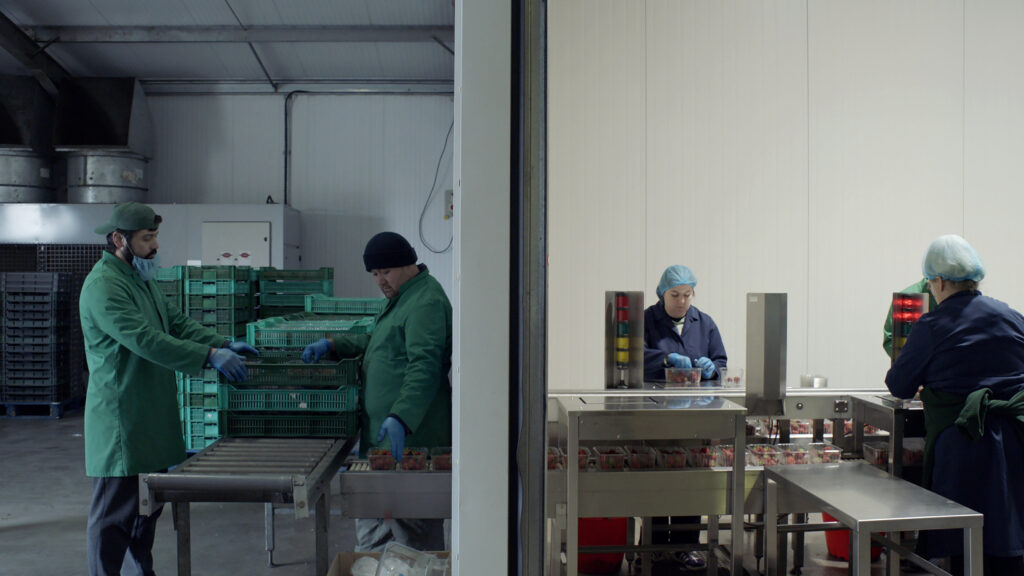
There is also a hardness – to the ordering of workers, the abruptness of decision making, the grading and discarding of fruit. As well as the farm, the film also takes us inside the sterility of a strawberry sorting plant (latex gloves, conveyor belts, tedious labour). Solarised film and juddering electronic noise evoke a sense of alienation commonly associated with industrial capitalism.
Those expecting a journalistic expose of egregious labour conditions will be disappointed. The hours are long, the work is exhausting, but there is little in the film to suggest any especially unpleasant or illegal practices. And perhaps this is the point: a focus on one controversy (a ‘bad apple’) might generate energies towards a singular fix. When really it is the system that is the problem – a system that continues to expropriate land for private ownership and loads people up with debt to compel them into exploitative wage labour. Soft Fruit is the first in a two-part film work, Plantation, currently also on show at Site Gallery in Sheffield. The title, Plantation, places this particular Angus community within a much broader history of extraction, from Francis Bacon’s 1625 essay, Of Plantations, to the slavery system of the colonial era.
Inside the sorting plant, you catch occasional glimpses of the Union Jack flags adoring the labels of the strawberry punnets. In the light of the UK’s increasingly rancid reverence for flags, I’m reminded of Sarah Maple’s It’s our flag video collage from 2018 (British chocolates, British daffodils, British meat, British sofas…) and of Harsha Walia’s precise analysis inBorder and Rule.There is nothing temporary about temporary labour programmes, argues Walia; some of those interviewed by Zaman return to the UK every year to work. Moreover, such seasonal labour is not an exception to the increasing militarisation of nationalist border regimes – it is part of the very structure that makes such border regimes possible.
HOPS, incidentally, is currently pushing technological “solutions” to a labour “crisis”, without which it would not exist. As their website says: “At HOPS we believe that – regardless of the immigration policies that successive governments adopt – the only truly sustainable solution is to speed up our clients’ adoption of innovative new technologies, whether this be in the form of software solutions to improve the utilisation of available labour or the deployment of hardware to reduce the reliance on high numbers of seasonal workers.” Given that the directors of HOPS also run a “recruitment and employee management platform under a separate company called Two Knitghs Ltd, I assume they basically mean increased surveillance to improve “productivity” and drones.
Soft Fruit subtly places this one community within wider historical and global contexts. A particular tragedy which the film gestures towards is this system’s self-perpetuation. When asked what they intend to do with the money they make picking fruit in the UK, one of the workers says they will invest it in property back home.
At the end of the film, we hear a little bit more about the processes that precede a worker’s arrival in the UK. They must apply for visas, pay for flights (often applying for loans to cover these upfront costs) and then they can arrive in the UK with no guarantee of work. In addition, the HOPS website says that: “Kenyan citizens who wish to apply for a place on the Seasonal Worker Scheme must have completed a course of study at one of our partner colleges.” During a poor harvest these workers may simply be sent away again, laden with debts they have no way to repay.
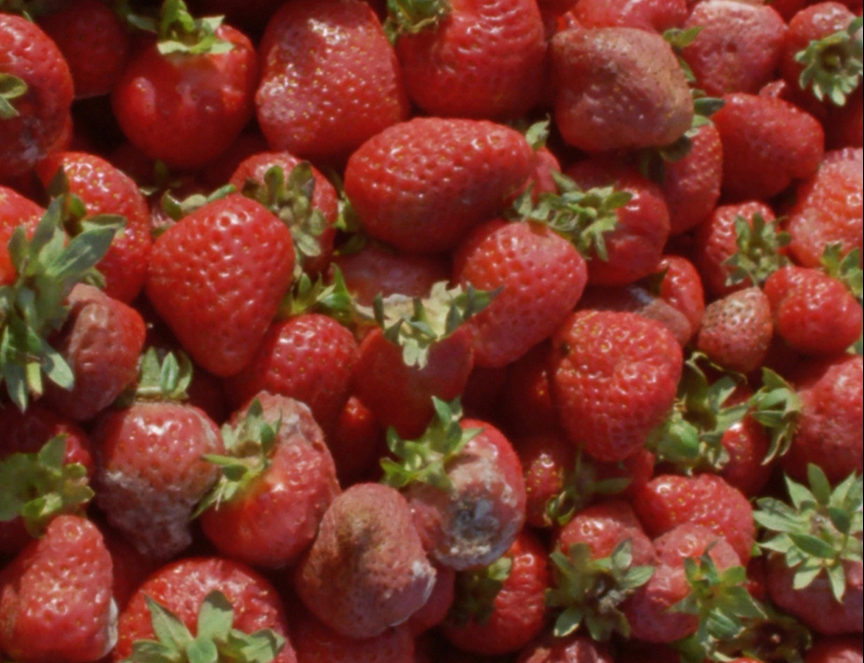
This expanded gesture to the lives of workers prior to their arrival in the UK is dealt with a little abruptly right at the end of the film, and I felt this could have been pressed further or the audience given more space to sit with its implications. Instead we are shown a green heap of discarded leaves and stems and a squishy red pile of strawberries, discarded as too soft, misshapen or otherwise unfit for luxury consumption. Silvia Federici has written of the “sacrifice zones” of global capitalism. Soft Fruit touches tenderly upon sacrifice bodies – those people deemed expendable under a system of relentless extraction, who are subjected to hate and violence by resurgent techno-nationalisms.
I’m reminded again of Kropotkin, who imagines collective agriculture freed from private property and capitalist extraction. Under such conditions, when workers own the means of production, including the land, agriculture becomes an affirmatory undertaking of physical exercise, just a few hours a day: labour as “a pleasure, a festival, a renewal of health and joy”. In its combination of tenderness and juddering abrasion, Rehana Zaman’s Soft Fruit suggests the need not only for critique of the conditions under which agricultural labour takes place today, but also for a desire to imagine, perhaps, blurry alternative futures of collective living and growing.
Tom Jeffreys
The film festival premiere of Soft Fruit was part of Berwick Film and Media Arts Festival, 2026.
Soft Fruit is also on show as part of Rehana Zaman’s solo exhibition, Plantation, at Site Gallery, Sheffield, until 17 May 2026.
rehanazaman.com