“The very precariousness of queer archives unsettles the ways in which conventional historical narrative opposes the ‘public’ and the ‘private’, sets history against gossip, pits stories against shards.”
– Catherine Lord, Inside the Body Politic: 1980-Present
Quis custodiet ipsos custodes? (“Who guards the guards?”)
– Juvenal, Satires
Guardian (I)
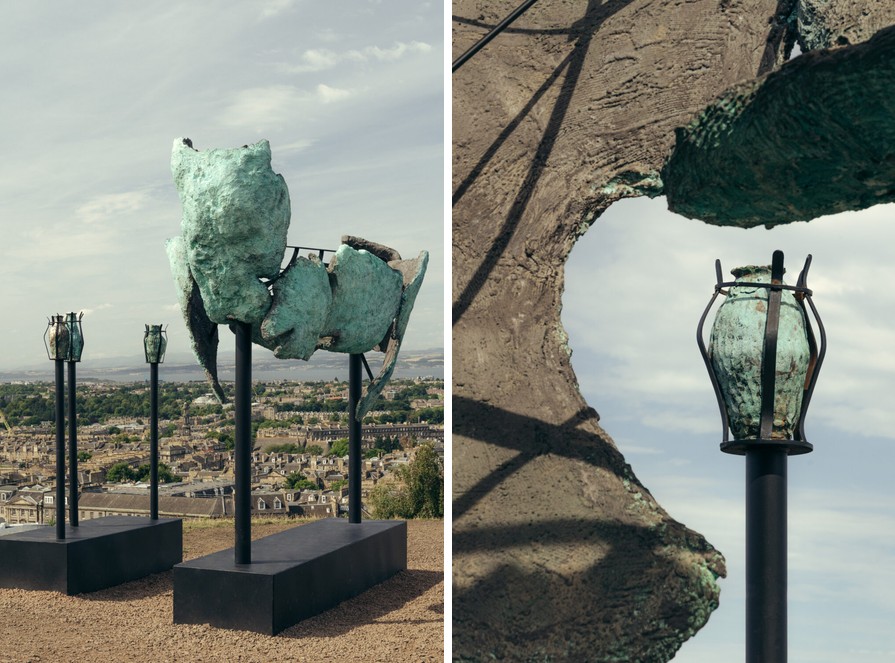
On the crest of Calton Hill is a new/old arrival: Guardian by Emii Alrai. A floating protective animal/deity, its form borrowed, morphed, flayed from that of the lamassu – a Sumerian god with the head of a human, the wings of an eagle and the body of a lion or bull. At the media view, the artist spoke of the various lamassu currently housed in the British Museum, stolen from modern-day Iraq and shipped to Britain in the mid-19th century.
Guardian may be new but it feels in a way like it has always been here. Yes, that has something to do with its fragmentary, peeling form, the imitation verdigris, the rough texture like something excavated from the belly of the hill itself. But perhaps context is also a factor. The black bases are already scuffed and dusty with use. Just a few days after the installation of Guardian, it was immediately in the centre of the huge crowds who gathered to experience the solar eclipse – which I feel like could be framed as a shared moment of non-capitalist gathering that was perhaps more beautiful than those expensive, extractive entities like the Edinburgh International Festival (“Don’t Think, Feel” 🤮) and the bloated corporatised Fringe will ever be.
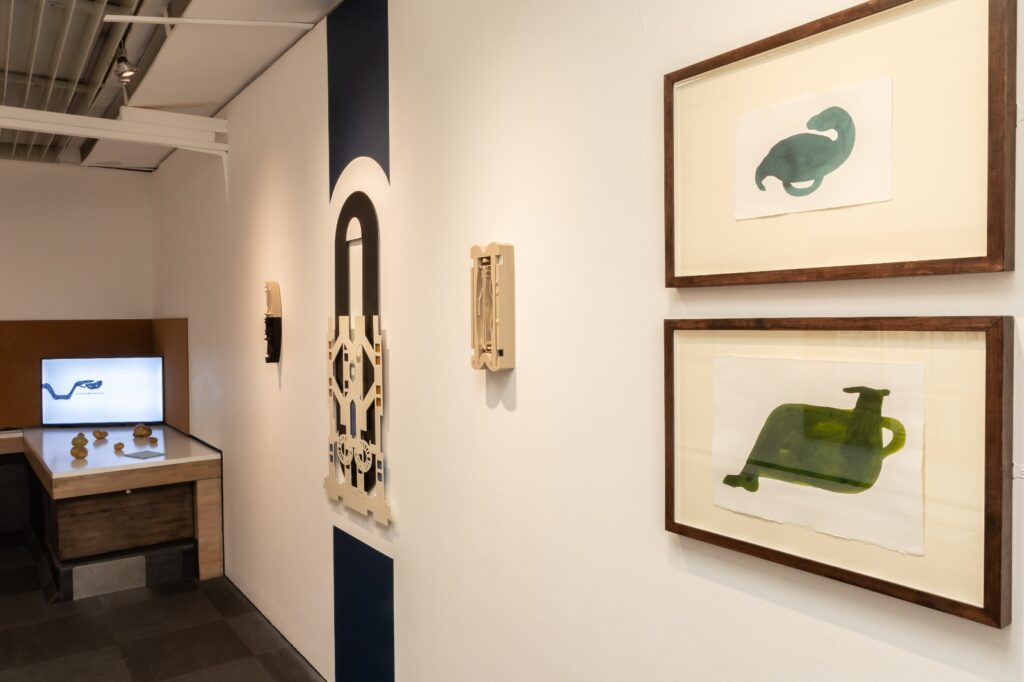
I wonder if the way Guardian feels so at home here is also because this is not Alrai’s first appearance at EAF, nor is it even the first time her work has figured on Calton Hill. Curator Jelena Sofronijevic’s brilliant, compact and rigorously researched 2025 exhibition SEEDLINGS included a pair of soft watercolour paintings of hybrid animal-like vessels painted in similar tones of lichen or verdigris. Guardian may be a new presence on the hill but the path that led it here was laid at least a year ago.
Standing beside or sitting beneath Alrai’s sculpture channels your vision inevitably north, towards the huge yellow structures (the underwater foundations of wind turbines), currently housed at Leith Docks and soon to make their way out to the North Sea. The imitation verdigris of the jesmonite picks up not only the copper domes of the City Observatory but also the chimney of the old paper mill between Leith Walk and Broughton Road. From one hollow, crumbling edifice to another.
The direction that draws your eye is also the direction that EAF has taken, gradually and now more decisively away from central Edinburgh towards Leith. It makes sense: Leith is where the city’s creative communities are located and the new space at 92 Constitution Street feels far more capacious and intentional as a home than the French Institute ever did. But it also follows a direction of travel long mapped out by city decision-makers who see central Edinburgh as a playground for tourists against a heritage backdrop rather than a place where people, including artists, might want to actually live, work and show work.
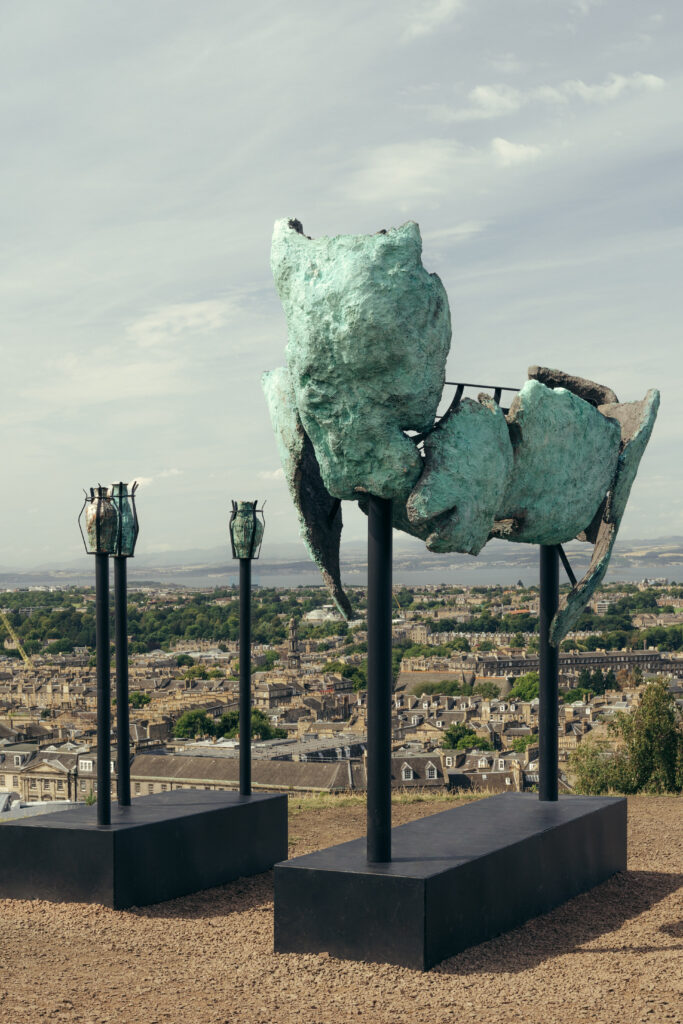
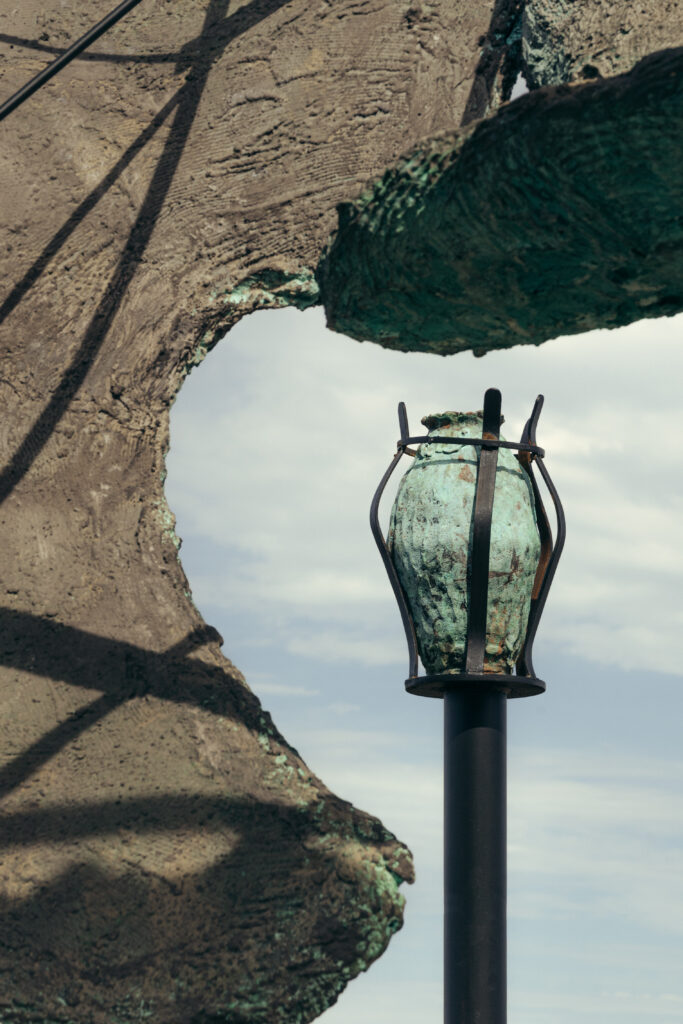
Guardian speaks directly to this conception of city as heritage backdrop, while providing, I think, both a warning and an alternative. In its writhing hybridity, the work offers a turning away from the scattered fragments of hubris that adorn the rest of the hill – the columns and the domes and phallic towers. For me there is a sense that Alrai’s work is what this dusty patch of ground – where tourists gather to take photos of the view – has long been crying out for. Spectacularly questioning the logic of spectacle, a monument collapsing the possibility of monuments.
Its title suggests that Guardian is here to protect something. But who or what? And from who or what? And, moreover, what does it say that its mighty form is in the process of decomposition? That it must be held aloft in place by a steel frame? That, surrounded by urns, its presence feels more funerary/memorial than truly protective. Lamassu, for all their apparent might, were ultimately unable to stop the ravages of British colonialism. After all, those ancient beings were not excavated from the belly of Calton Hill, but cut from their contexts in Sumeria and transplanted by white colonialists to British museums and collections. We can demand reparations for the violent colonial extraction that brought lamassu to Britain, while at the same time refusing to align with a logic that places our trust in supposedly higher protective powers like deities, monarchs and states.
Guarded
EAF director Kim McAleese isn’t given to grand curatorial statements and this year there is even less than usual by way of overarching critical framing for the festival. Instead, the programme does the talking, and the more you attend the more you build up a sense of certain recurrent priorities – most notably a centring of queer cultures, celebrated through an event-driven approach to live programming and placed in longer contexts of marginalisation and resistance through sustained attention to the importance of archives.
Long-term relationships with folks like Lavender Menace Returns, Trans Masc Studies, Community Wellbeing Collective, Falastin Film Festival and Scotland for Decrim embed this work within local Edinburgh communities. Or rather, the work grows out of this embeddedness. With parts of the Lavender Menace archive currently on display at the Museum of Edinburgh, a major exhibition at City Art Centre of work by Sandra George (whose photographic archive is held by Craigmillar Now), and Richard Maguire’s taught, theoretically complex and lingeringly beautiful solo show at Collective Gallery, EAF’s archival focus feels like it’s tapping into a whole thing.
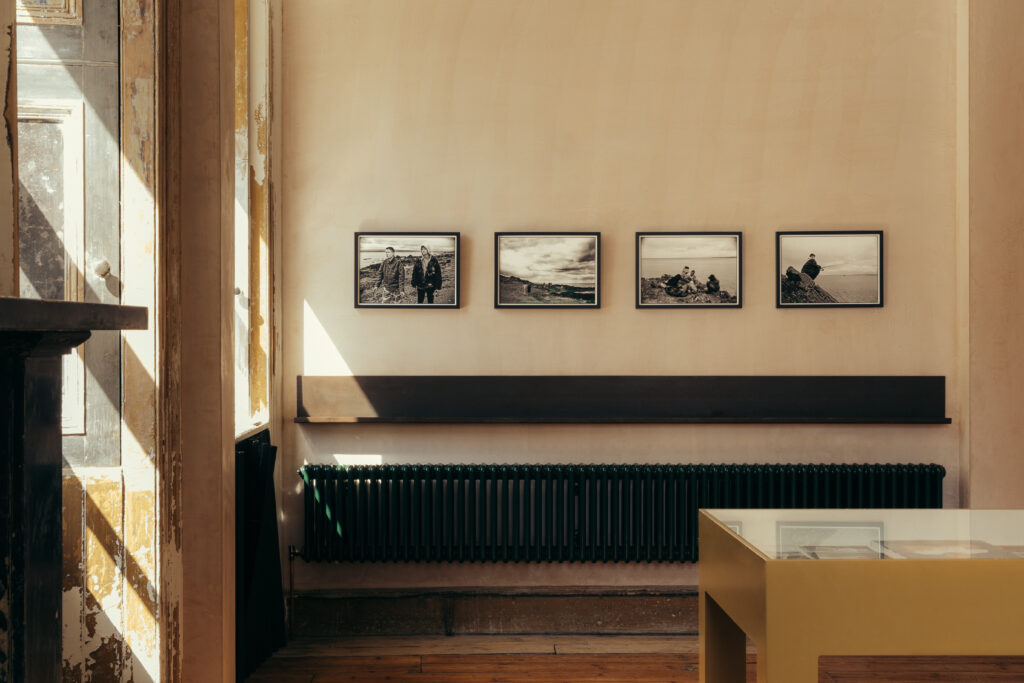
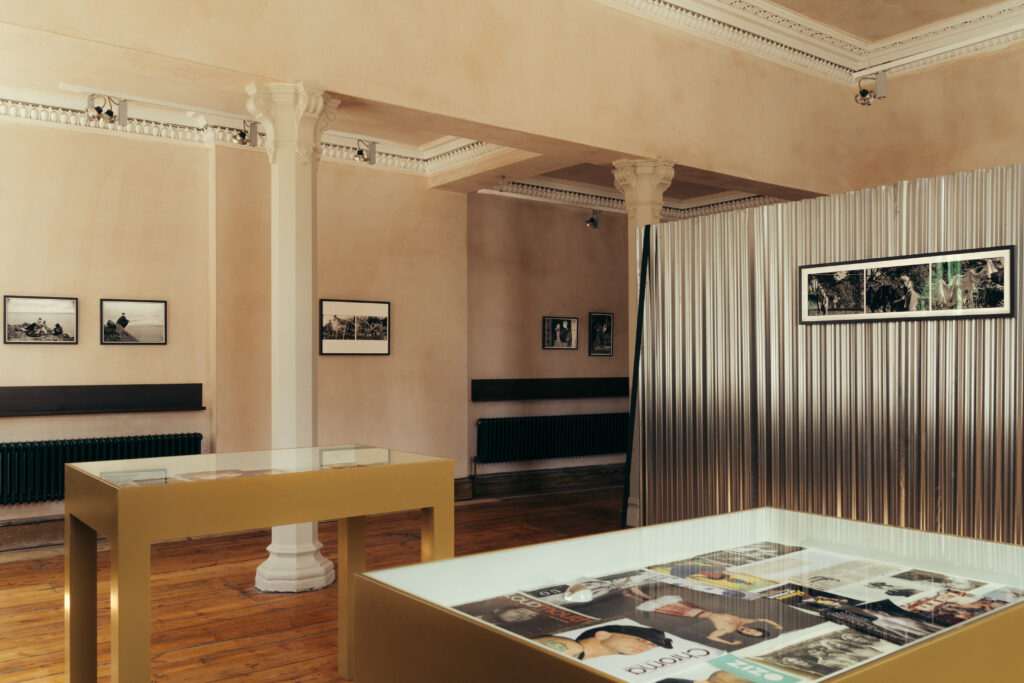
At the festival’s new home are photographs from the archive of Del LaGrace Volcano, produced between 1982 and 1995. The exhibition connects to the city through a series of works produced in Greyfriars churchyard and there are also images from a range of places and contexts – from cute beach walks to BDSM club nights. Catherine Lord speaks of the way that archives in queer culture function as both “mourning and monument” and you can really feel this in the way Del speaks about the works. There is joy and humour, hotness, but also grief. Several of those depicted here, Del notes, have lost their lives in tragic circumstances. So, in its making public of a personal archive, the exhibition is both celebration and mourning, and above all perhaps a paean to a community whose very existence has been at times an act of resistance. (In potted parenthesis, fuck Clause 28. I was 19 by the time that toxic bullshit was repealed and I am still thinking about the multiple ways it shaped my childhood and adolescence.) In addition to the images themselves, I’m very taken with some of the display structures: shiny corrugated metal held to a line of breeze blocks with a kind of heavy-duty black harness. In the artfully peeling space of 92 Constitution Street, it’s a moment of hardness – one kind of restraint in the context of another.
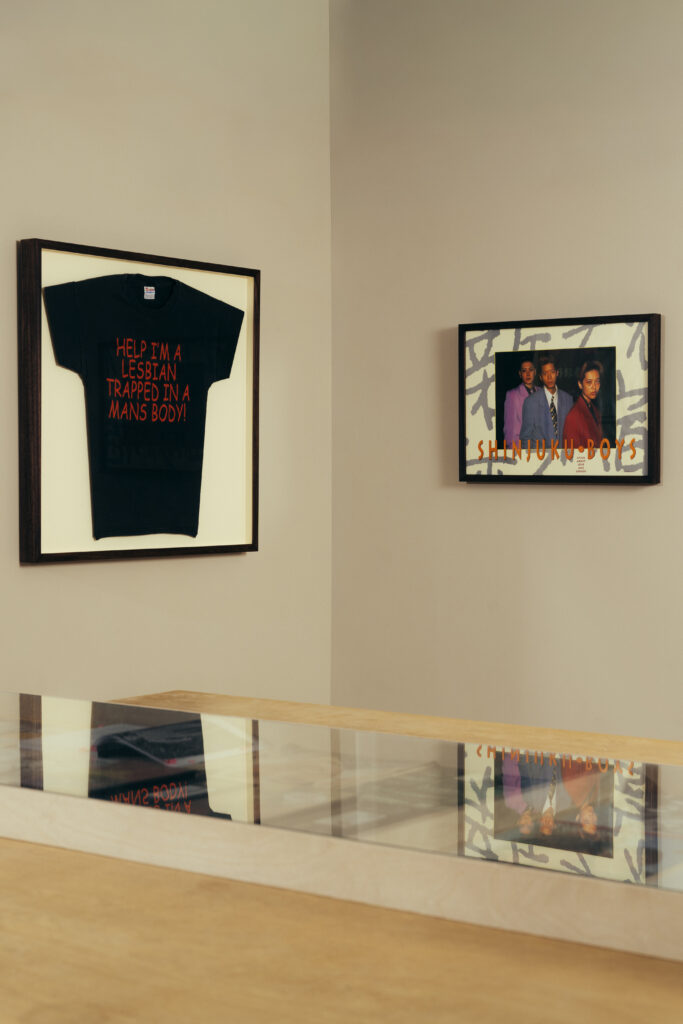
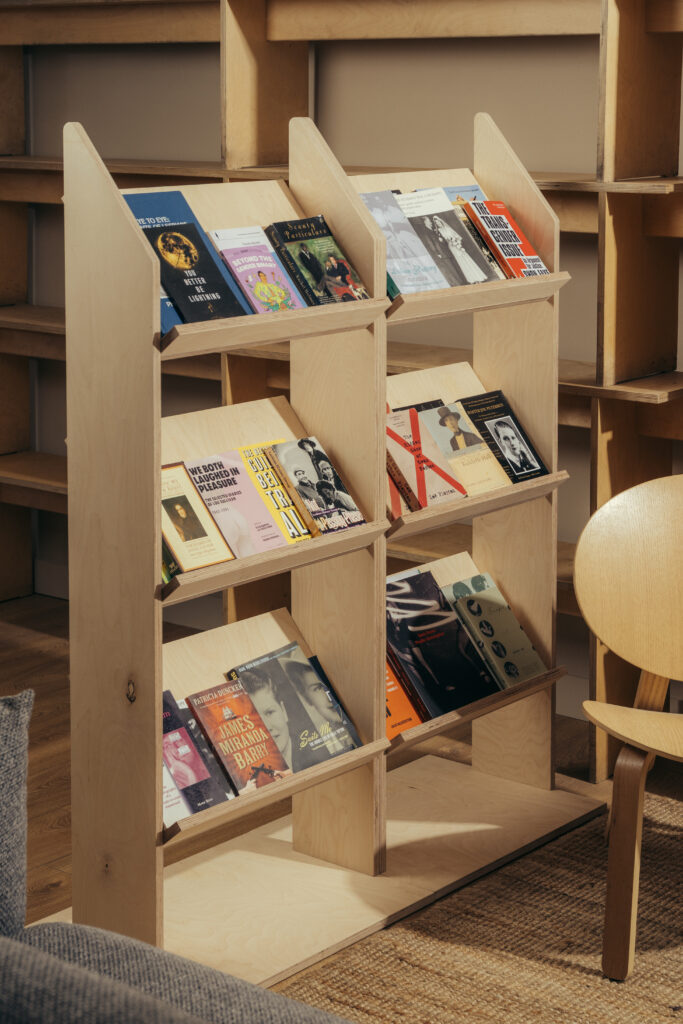
At Custom Lane are two further engagements with the importance of archives in queer culture. An exhibition, reading room and research space has been put together by Ellis Jackson Kroese of Trans Masc Studies to present their research and collection of books, zines, artworks and other ephemera – from She’s the Man to Shinjuku Boys. In the adjacent space, an exhibition of work by Japanese graphic artist Sadao Hasegawa, known for his explicit and highly imaginative depictions of men fucking, foregrounds the repression and secrecy that surrounded the production of his work. As Christopher Whitfield’s brilliant accompanying essay, A Tale of Two Tanktops, opens: “In the empty space left by the absence of cock, there is nothing but cock.” This was an archive that came to wider attention only after the artist’s death and many of the works have not been exhibited before.
All three of these exhibitions point towards not only the joys and complexities in community but also the importance of those who hold onto and protect the material production of marginalised cultures – the artists, librarians, archivists, collectors of ephemera, those who document / bear witness… If we’re thinking about guardians, away from the archontic principles of state power (the archive sited in the home of the magistrate), maybe we can see folks like those who run Trans Masc Studies and Lavender Menace as alternative forms of lamassu. I mean, who wouldn’t want the body of a lion and the wings of an eagle?
Guardian (II)
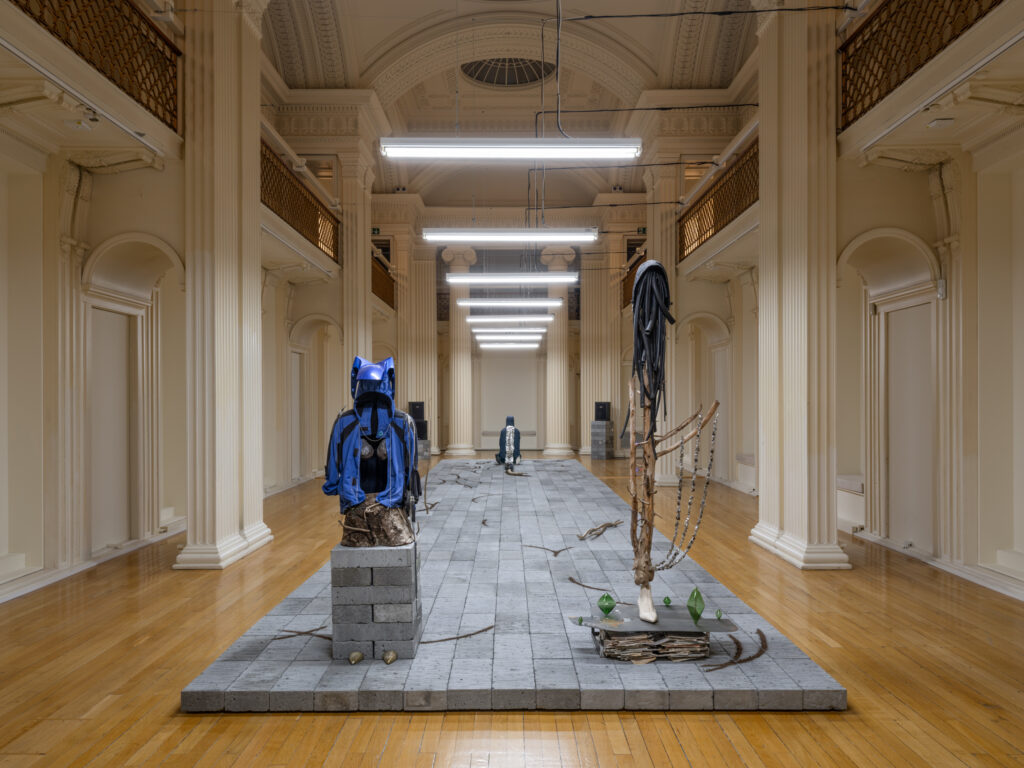
In Talbot Rice, there is another guardian, like Alrai’s Guardian atop Calton Hill, also ambiguous, also hollow – albeit, I think with different connotations. Anne Hardy has responded to the Georgian gallery, filling the floor with grey tiles, which form a kind of long dais for a diorama of figures, found and cast objects. In an accompanying video, Hardy speaks of the space as akin to a church, tomb or mausoleum and certainly in her handling there is a sense of reverence and ossification. The entrance to the space is bracketed by two figures, whose hybrid forms are, let’s say, lamassu adjacent. On the right is Being (Guardian) – yes, a second guardian – formed from a length of tree, stripped of bark, and held up by a steel frame. The figure has a single shoe, a cast white heel, three lengths of silver buttons strung from branch to trunk. The impression of a head is created by a hood removed from an anorak and a tangle of black dangling bicycle inner tubes.
For an artist attuned to the sensitivities of communication technologies, the inclusion of a stack of New York Times newspapers (upon which the Guardian figures stands) is interesting. The paper is subject to a global boycott for manufacturing complicity in the ongoing genocide in Palestine. Is this stack of old propaganda something to protect in Hardy’s imagined dystopia? And what is being said if so? Maybe the Guardian figure is here to prevent people from reading its toxic contents. Maybe Hardy, who has worked with the Zabludowicz Collection and The Israel Museum, is simply unaware of current perceptions of the paper.
The exhibition is reminiscent of another Talbot Rice festival show, Lucy Skaer’s The Green Man from 2018. But where Skaer’s arrangements traced rich specificities, here Hardy speaks mostly in generalities. I’m also reminded of Dineo Seshee Bopape’s 2019 exhibition, when spirituality was a baby, at Collective Gallery (something of a touchstone exhibition for me). Materially, Hardy’s is a rich and intriguing exhibition, but, returning for a second visit, I find it all a bit disappointing. The accompanying materials include allusions to technology, AI in particular, but these are vague. Bopape traced a rich whirl of meaning through the material world; Hardy seems somehow to have rinsed meaning away and we end up with little more than generic sci-fi vibes. Hardy’s thinking feels like it rests on tired-out appeals to universalism, the well-spoken white woman standing in for all of humanity in those broad sweeping ‘we’s that seem not to have meaningfully considered who is being included in such statements and who is excluded. The emptiness of the figures is a sadly literal manifestation of the emptiness I feel throughout. Hardy says things like “all the works relate to different ways of being and feeling”. I guess the title – Feelings – was a clue. Loose lines made from earth have a ritualistic feel but stripped of contextual specificity or even much sense that rituals are meaningful, culturally situated practices. It feels a bit like form gutted for aesthetics. Hollowness not as critique but as the end of thinking.
Unguarded
Archives are never only a question of the past. They are forged by and help to open up certain conceptions of the future. The subject is also a live one, not simply because of the ‘archival turn’ in contemporary art, but more pressingly right here and now. Lavender Menace is at risk of closure once again and they are currently raising funds (supported by EAF).
Another archive at risk is that of Third Eye Centre – which may be broken up because of the ongoing actions of Creative Scotland around the proposed sale of Glasgow CCA. The mismanagement and lies peddled by Creative Scotland, the refusal to engage with communities, the evasiveness when meetings do occur, and the complete opacity of decision-making processes is both astonishing and unsurprising. The building and its role as a host a multiplicity of cultural goings-on is where my affections lie, but the potential sale or breaking-up of the archive is also a travesty that those who claim to represent Scotland’s creative communities must do more to prevent. And no, instagram posts and petitions are not enough.
In thinking about Creative Scotland, I think again about Alrai’s Guardian. If the work is telling us anything, it is that the crumbling institutions (states, deities, universities, public bodies, museums, galleries, unions etc) entrusted to protect what we (or some of us at least) once agreed matters (shared histories and cultures, the possibilities of creative futures) will not protect the material cultures entrusted to them and they will not protect you. We have to fight together for what matters and yes it’s fucking tiring.
Creative Scotland’s opacity has been deliberate but allowing it to be perpetuated has also been a strategic misstep from campaigners. All of the Creative Scotland board and its senior management are listed on the website. A stand-out name among so much mediocrity is Robert Wilson, chair of the Creative Scotland board, and owner of Jupiter Artland, and a major partner of EAF. Street protests and open letters, petitions and instagram posts: the effect of all these words has been minimal. It is time to use the leverage we have as art workers: our labour. And by ‘use’ I mean ‘withdraw’. Why? Because it works.
Tom Jeffreys
Image credits
1 & 2. Emii Alrai, Guardian, EAF26 installation shots
3. SEEDLINGS, Travelling Gallery installation shot, 2025. Credit: Sally Jubb and Travelling Gallery
3. Del LaGrace Volcano, Love Bites Back, EAF26 installation shot
5 & 6. Trans Masc Studies, History is a Home, EAF2 installation shots
7. Exhibition view, Anne Hardy, Feelings, Talbot Rice Gallery, the University of Edinburgh. Installation with lighting that responds to meteorological data, and quadraphonic audio (6:30 mins looped with 1 minute pause) © Anne Hardy, Photo: Angus Mill
8. Del LaGrace Volcano, Love Bites Back, EAF26 installation shot


1 Comment
Really interesting review, thank you Tom. I sometimes struggle with the art festival feeling like it posits itself as super “trendy” in a way that can sometimes feel exclusive and actually a barrier to engagement. But you have given me pause for thought. Especially this: “So, in its making public of a personal archive, the exhibition is both celebration and mourning, and above all perhaps a paean to a community whose very existence has been at times an act of resistance.” Thank you.