As its beautiful title suggests, something about drawing as an originary practice sits at the heart of Shahana Rajani’s brilliant exhibition, Lines that World a River, the latest iteration of which is at Nottingham Contemporary until 10 May. I say ‘originary practice’ but I’m also wary of attributing too much explicatory power to origins. Maybe ‘generative practice’ is better – for drawing is generative, drawing is creative. It makes worlds – for better and for worse. And practice, as something that does not exist outside of its doing, attunes us to the possibilities of fluctuation through repetition.
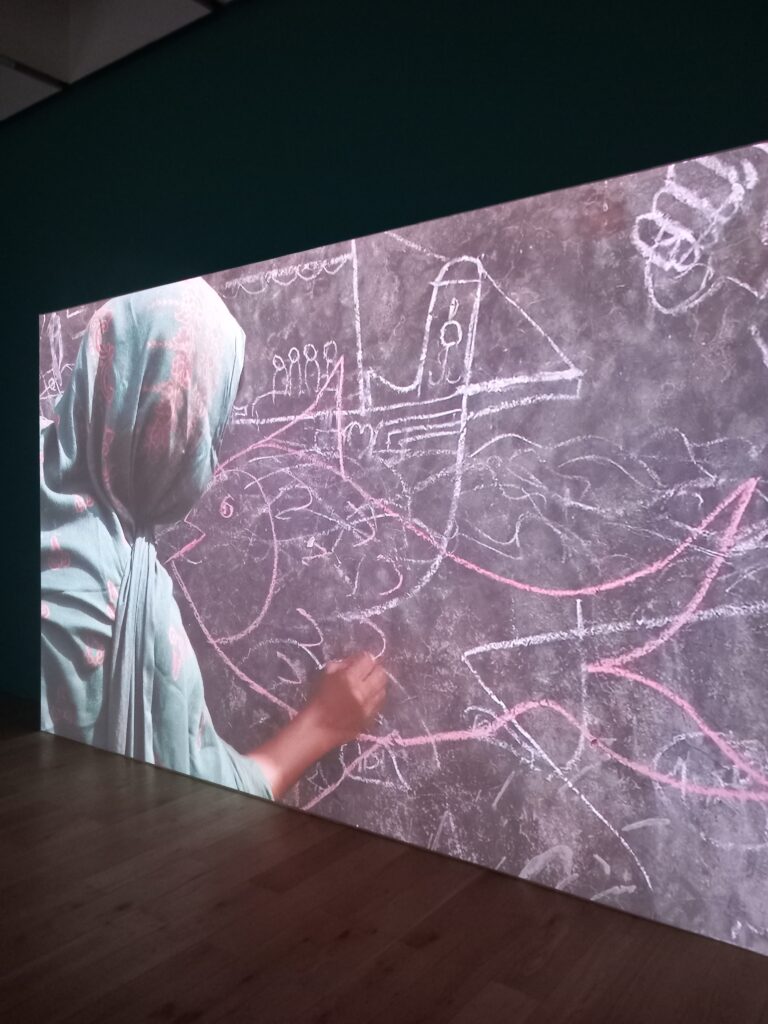
At Nottingham Contemporary, the work takes several forms. Filling most of the space is a three-screen film installation that centres on indigenous communities living in the delta of the Indus river. The film focuses on the painting, drawing, fishing, and ritual healing practices of these communities. There is also a short, upbeat animation made by Aziza Ahmed from a series of workshops with children in the region, as well as paintings by two of the community’s artists, Ustad Abdul Aziz and Abdul Sattar.
I recently overheard Crystal giving an online talk in which she argued that it was not possible for a contemporary artist to work in a way that was 100% non-extractive. Rajani also has concerns about extraction. During a talk the day after the exhibition opening, she speaks about concerns over representation in relation to hierarchies of art form (working in film to engage with practices such as drawing and painting), but I wonder if it’s more salient to think about hierarchies of display context. It’s an open question. In the talk, Rajani speaks about the care involved in building “slow and deep relationships” over the course of 10 years. You don’t pitch up as an artist wanting to make work in a place, she says. Ahmad’s animated film has been a collaborative work and the animation workshops are ongoing. Rajani has hosted screenings for the community and contributed to mutual aid efforts during the devastating floods of 2025. “What’s important is learning, sharing, doing research, building solidarity. The work is the last thing that comes.”
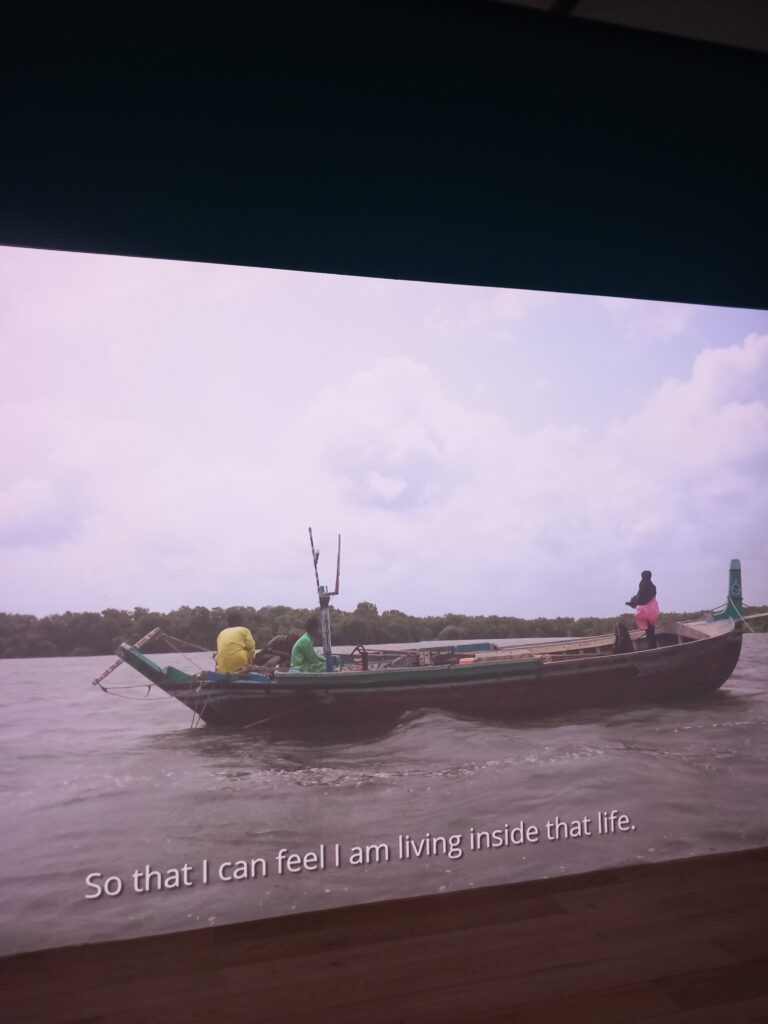
In the exhibition, context is provided by the accompanying hand-out, which describes colonial attempts since the nineteenth century to “fix and control” the River Indus via “endless dams, barrages and canals”, how these have reduced the flow of the river into the delta, and the disastrous impacts on ecosystems and communities now increasingly vulnerable to rising sea levels and coastal erosion. I’m reminded of course of the work of Anuradha Mathur and Dilip da Cunha, who in a Pew Fellows interview in 2018 wrote that: “[Water] refuses to stay behind a line drawn to separate it from land, prompting us to question not just who drew this line and where they drew it, but why they saw drawing it as necessary in the first place.”
Similarly, in her talk, Rajani speaks of the “bizarreness and absurdity of colonial maps of the Indus River”, which were characterised by an obsession with detail and narrow understanding of accuracy. In reality, she says: “In the delta there is no line that separates land and water. They are two bodies that are constantly interacting with each other.” In contrast to the fixing drive of the colonial imaginary, the indigenous community’s paintings are not only joyous, abundant and unscarred by infrastructural mega-projects but they also display, for Rajani, “an understanding of ephemerality”.
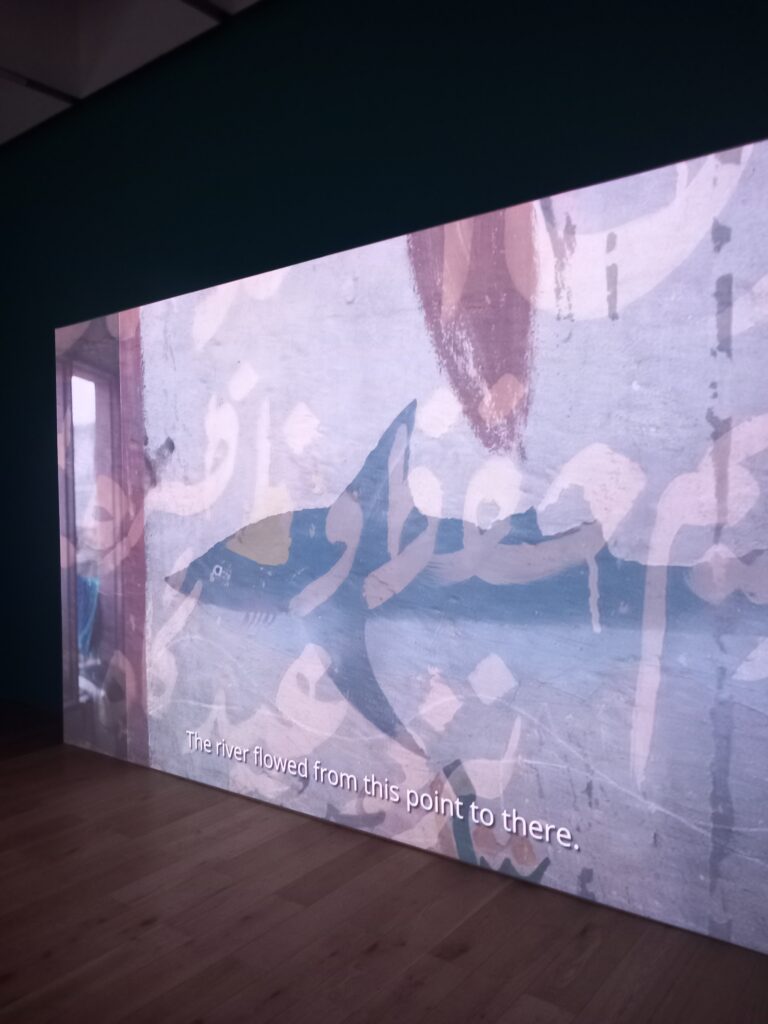
Rajani is referring specifically to the community’s approach to murals, which are frequently lost, altered, or repainted to keep them updated – both as they are subjected to erosion and as the villages they depict are lost to the sea. What Rajani emphasises is that, for the indigenous artists, it is the gestural process of making through which the river is invoked, rather than in some subsequent obsession over conservation. This is a dynamic approach to the making of images as “living maps” that Rajani contrasts both to the colonial drive to fix knowledge and to the post-9/11 mural projects funded by USAID across Karachi. “To paint the mural is a way to keep the river alive,” she says. This holding open of meaning and time is, I think, also echoed in the form of the film itself.
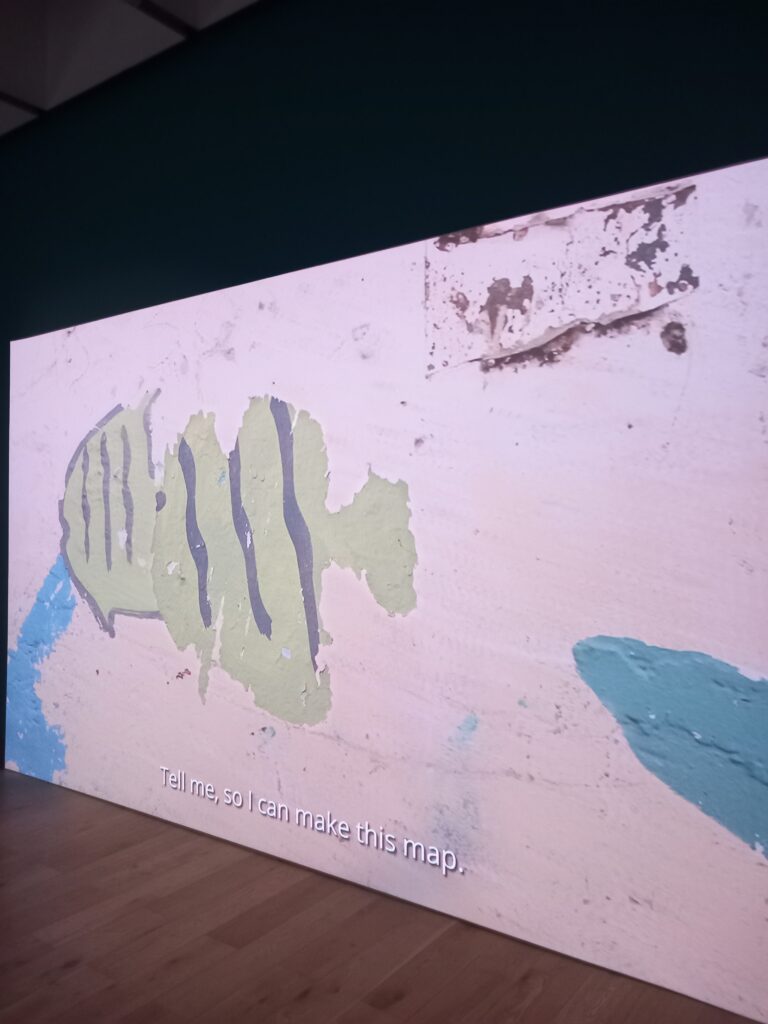
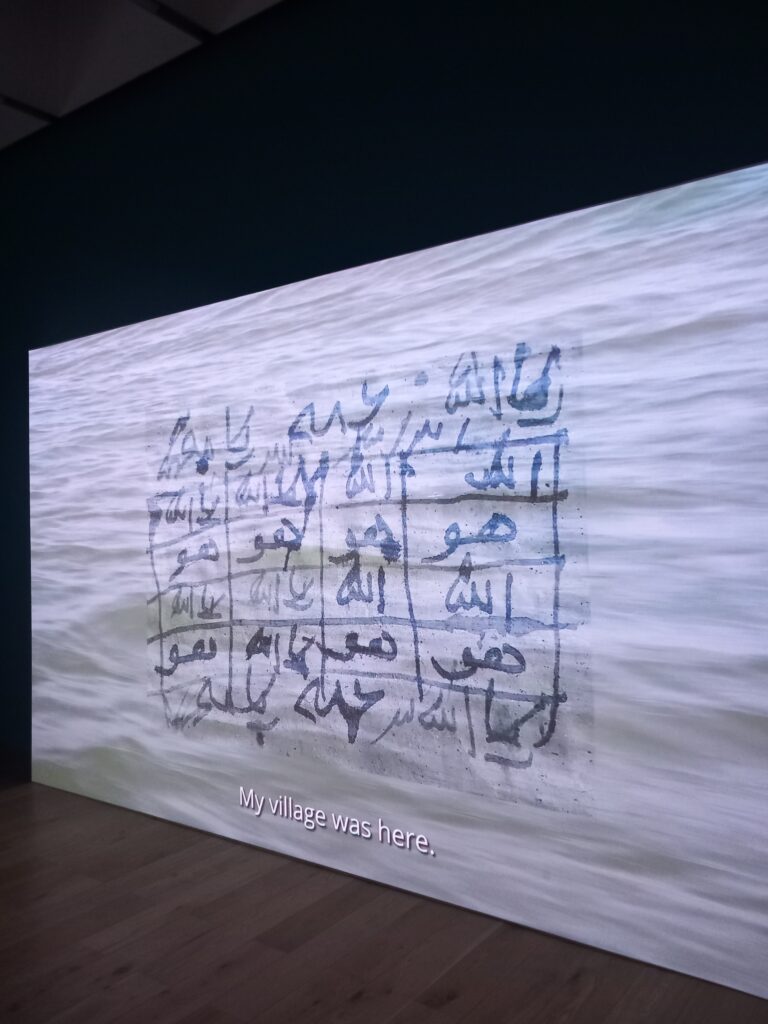
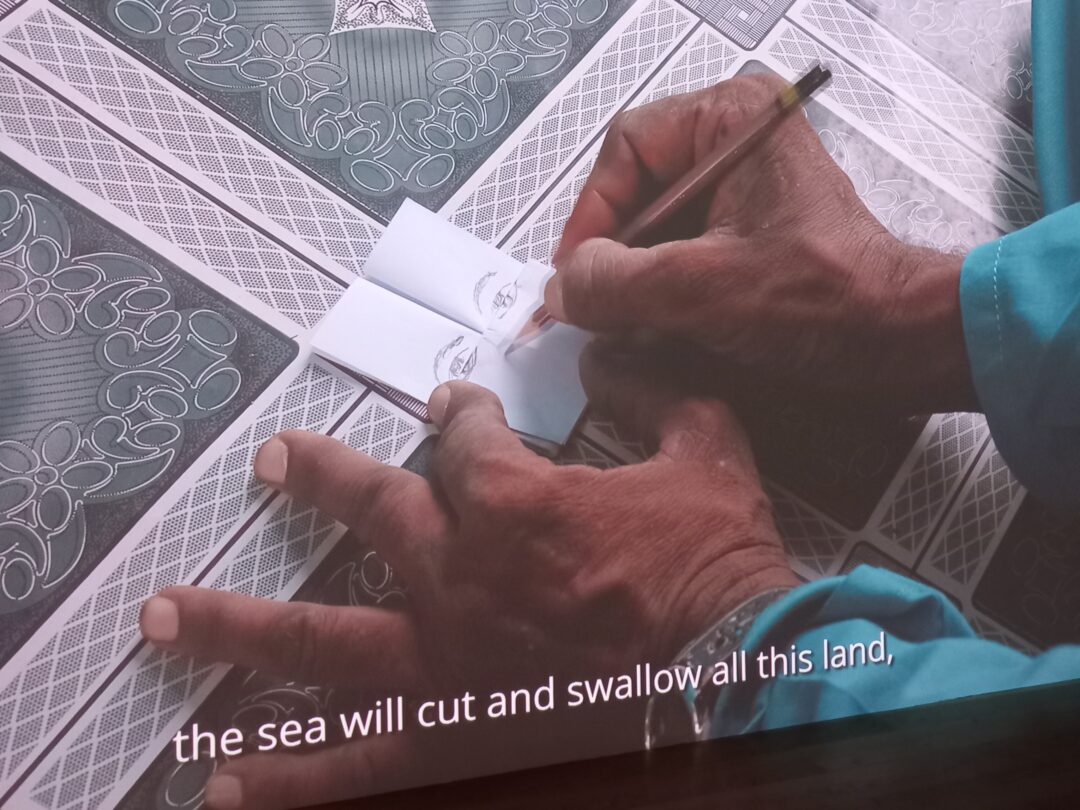
The three-screen work is under 15 minutes and feels straightforward at first. There are easy moments to enjoy immediately – the making of a paper talisman, the mesmerising painting, especially of all the tiny jewel-like details. But the longer you spend with the work, the more rich, complex and multi-layered it becomes. Through a series of slow fades, the surface of the water and the surface of the murals blur together so that the film might be seen to re-enact the washing away of the drawn marks through its own form, at the very same time that, alongside the subtitles, drawing is extended through the film to exist upon the water – the waves themselves becoming the substrate-in-flux for a kind of mark-making so fleeting that it hardly leaves a mark.
An emphasis on the generative power of the drawn line also connects Rajani’s work to that of Dala Nasser, who has a concurrent solo exhibition at Nottingham Contemporary which I’ve reviewed for Frieze. There are actually numerous points of connection between the two exhibitions. Both play host to a multiplicity of mark-making practices, grapple with loss and mourning, and engage in community-situated resistance to cultural erasure. Both exhibitions also point outwards to a constellation of communities, forms of knowledge, making traditions and belief systems. For Nasser, the drawing of lines is by and large a present absence – a historical moment in the exercise of colonial, bureaucratic power, speaking through abstractions which manifest as ongoing violent ground-level realities and continue to this day. Since I attended the exhibitions in early February, the zionist entity – not content with thousands of violations of the supposed “ceasefire” – has once again begun bombing Beirut, smearing white phosphorous across southern Lebanon, and attempting, in the words of one zionist commentator making reference to the Sykes-Picot agreement, to engineer a war that “finally erases the map drawn by Britain and France in 1916”.
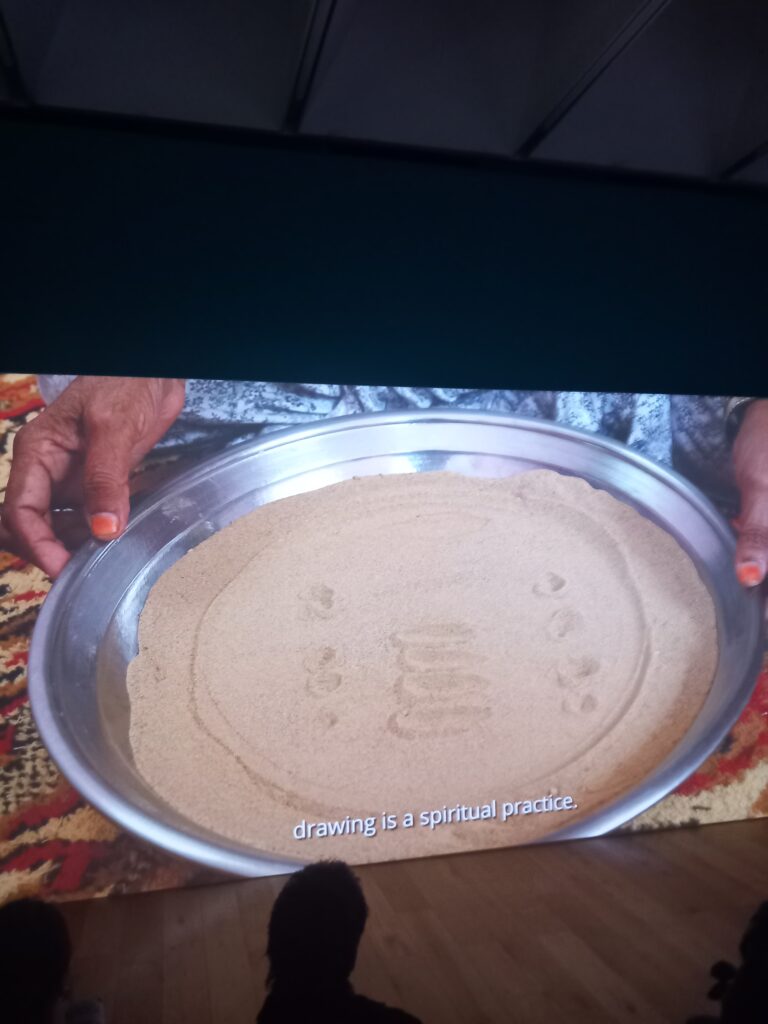
Colonial abstraction, division, conquest and extraction are starting points in Rajani’s work too. But in Lines that World a River, drawing also has a different mode of possibility: situated, material, mythical. Maybe let’s even say magical. Drawing, for Rajani in this context, is “not only a colonial imposition but also a sacred and creative practice”. Jacques Derrida’s 1993 book, Memoirs of the Blind, springs to mind. In the book, Derrida approaches drawing as embodied, material practice with the potential to function as both normative/controlling and creative/liberatory. Derrida writes: “The experience or experimenting of drawing (and experimenting, as its name indicates, always consists in journeying beyond limits) at once crosses and institutes these borders…”
In Lines That World a River, something similar manifests via a short piece of footage that shows a person’s hands making dots in a plate of sand, followed by a series of lines to connect them. This is ilm al-Raml – the science of the sand – a system of divination also known as geomancy. This kind of drawing is spiritual as well as material, a gift from god delivered by the angel Gabriel. Drawing creates, locates, connects. It is also, in this tradition as in that of the murals, more about the process of making than the mark that is made. During her talk, Rajani briefly touches upon the Islamic creation myth of Adam and Hawwa. It was through drawing, she says, that Adam found his way back to Hawwa after they were cast out of Paradise to opposite ends of the earth. Drawing is how we navigate the world. A river is also a gift from god. Or as Rajani puts it: “The drawing of each line becomes an invitation – to know, to love, to protect, to remember.”
Tom Jeffreys
Shahana Rajani, Lines That World a River, and Dala Nasser,Cemetery of Martyrs, are both at Nottingham Contemporary until 10 May 2026.